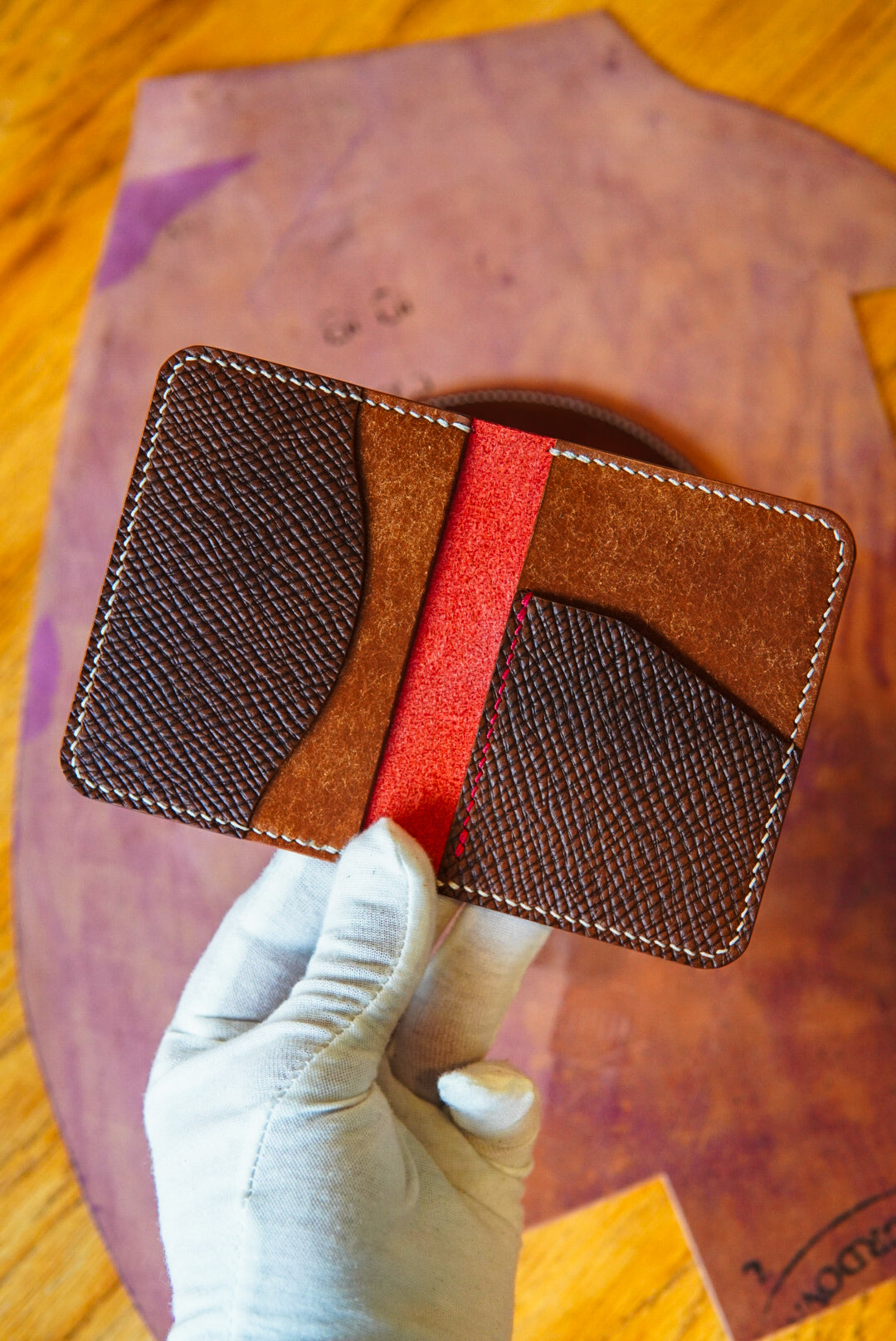
Types of Leather Explained: Full-Grain, Top-Grain, Suede & Shell Cordovan
Not all leather is created equal. From rugged full-grain leather to soft suede and beautifully finished shell cordovan, different types of leather have their own characteristics, strengths and uses.
But if you've ever shopped for a leather wallet, bag or accessory, you've probably come across terms like full-grain, top-grain, genuine leather and vegetable-tanned leather.
What do they actually mean? And which type of leather is best?
As a leatherworker, I've spent years experimenting with different materials, and one of the things I've learned is that there isn't one perfect leather for everything.
Here's a breakdown of the main types, how they differ and what to look for when choosing a leather product.
Full-Grain Leather
Full-grain leather retains the natural grain surface of the hide without sanding it away to remove imperfections.
Because the grain remains intact, it can display natural markings, scars and variations in texture.
Full-grain leather is often prized for its strength, appearance and ability to develop a patina over time.
Common uses: Wallets, belts, bags, footwear and other durable leather goods.
One thing I particularly enjoy about full-grain leather is how it changes with use. A wallet can gradually darken, soften and develop its own character.
However, full-grain leather isn't automatically superior for every application. The quality of the hide, tanning process, finishing and construction all matter.
Top-Grain Leather
Top-grain leather comes from the outer portion of the hide, but the term is sometimes used differently across the leather industry.
In retail descriptions, it often refers to leather whose grain surface has been lightly sanded or corrected to create a more consistent appearance.
This can remove some natural markings and produce a smoother, more uniform finish.
Common uses: Handbags, furniture, jackets, footwear and leather accessories.
Good-quality top-grain leather can be strong, attractive and long-lasting.
The important thing is not to assume that a leather product is poor quality simply because it isn't described as full-grain.
Genuine Leather: What Does It Actually Mean?
One of the most misunderstood terms in leather goods is genuine leather.
You've probably seen it stamped on wallets, belts and bags.
Despite what some online leather guides claim, genuine leather isn't a universally defined grade sitting below full-grain and top-grain.
It generally indicates that a product contains real leather rather than an entirely synthetic substitute.
However, it doesn't tell you much about the quality, which layer of the hide was used or how the leather was processed.
A product labelled genuine leather could be made from different types and qualities of leather.
My advice: Rather than relying on the words genuine leather, look for information about the tannery, leather type, construction and finishing.
Those details tell you much more about what you're buying.
Split Leather and Suede
Animal hides can be separated into different layers.
The lower layers are known as splits, which can be processed into various leather products.
Suede is commonly made from split leather and has a soft, fuzzy surface created by buffing the fibres.
Its texture makes it popular for shoes, jackets, bags and accessories.
Common uses: Footwear, clothing, bags and decorative leather goods.
Suede has a beautiful feel, but it generally requires more care around water, dirt and stains than many smooth, finished leathers.
It isn't necessarily less useful or less desirable. It simply has different properties.
Nubuck Leather
Nubuck is often confused with suede because both have a soft, velvety surface.
The difference is that nubuck is generally produced by lightly sanding or buffing the outer grain side of leather.
This creates a fine nap while retaining the characteristics of the grain layer.
Nubuck can feel luxurious and is often used for footwear, bags and upholstery.
Like suede, it needs appropriate cleaning and care to preserve its appearance.
Vegetable-Tanned Leather
Vegetable-tanned leather is one of my favourite materials to work with.
Unlike terms such as full-grain and split leather, vegetable-tanned describes how the hide has been tanned, rather than which layer of the hide was used.
The process uses tannins derived from plant materials such as bark, leaves and wood.
Vegetable-tanned leather is often associated with traditional leathercraft because of its working characteristics and ability to develop a distinctive patina.
Two Italian leathers I enjoy working with are:
Buttero Leather
Buttero is known for its smooth finish, firm temper and refined appearance.
It's particularly suited to structured leather goods such as wallets and cardholders.
With use, the surface can develop a richer colour and subtle sheen.
Pueblo Leather
Pueblo has a distinctive textured surface and a more rustic appearance.
It's one of those leathers that can change noticeably as it's handled, gradually becoming smoother and developing character.
Both materials offer different experiences, even though they're vegetable-tanned.
You can learn more about the materials I work with in my Leather Guide.
Chrome-Tanned Leather
Chrome-tanned leather is produced using chromium-based tanning agents, most commonly chromium(III) salts.
This process can create leather that's soft, flexible and suitable for a wide variety of applications.
It's commonly used in footwear, upholstery, clothing and accessories.
Chrome-tanned leather isn't automatically lower quality than vegetable-tanned leather.
Both processes can produce excellent materials, and both have environmental considerations.
The right choice depends on the desired characteristics of the finished product.
Shell Cordovan: A Special Type of Leather
Shell cordovan is one of the most distinctive leathers I work with at Lighthouse Leather Co.
Unlike conventional grain leather, shell cordovan is made from a dense fibrous layer found within the hindquarters of a horsehide.
It's carefully processed to create a smooth, compact surface with a characteristic lustre.
Shell cordovan is known for its appearance, density and the way it develops character with use.
Two tanneries whose shell cordovan I work with are Horween, based in the United States, and Rocado, based in Italy.
Each produces leather with its own colours, finishes and character.
Shell cordovan is particularly appealing for smaller leather goods, where its distinctive surface can be appreciated.
It's one of the reasons I enjoy making handmade leather wallets and cardholders using this material.
Which Type of Leather Is Best for a Wallet?
If you're choosing a leather wallet, the best material depends on what you value most.
For natural ageing and patina: Vegetable-tanned leathers such as Buttero and Pueblo can be excellent choices.
For a smooth, distinctive finish: Shell cordovan offers a unique appearance and feel.
For a softer wallet: A supple leather with a softer temper may be more suitable than a firm, structured material.
For everyday durability: Look for quality leather combined with good stitching, sensible construction and an appropriate design.
Leather type matters, but craftsmanship is just as important.
A beautifully finished piece of leather won't make up for poor construction.
That's why I spend time thinking about how each leather will behave before deciding how to use it.
How Can You Tell If Leather Is Good Quality?
There isn't one simple test that determines whether leather is good.
But there are a few things worth considering.
-
Material information: Does the maker explain which leather they've used?
-
Tannery details: Can they identify where the material comes from?
-
Construction: Are the stitching, edges and overall design carefully finished?
-
Suitability: Is the leather appropriate for the product?
-
Long-term use: How is the leather expected to change with handling and wear?
A good maker should be able to explain why they've chosen a particular material.
For me, understanding those differences is one of the most enjoyable parts of leathercraft.
My Approach to Choosing Leather
At Lighthouse Leather Co., I work with a range of materials, including Italian vegetable-tanned leather and shell cordovan from Horween and Rocado.
I don't choose leather simply because it's expensive or carries a particular label.
I choose it for its appearance, working characteristics and suitability for the product I'm making.
Some leathers are beautifully smooth, others are rustic and textured, and some develop remarkable changes over time.
That's part of what makes working with leather so interesting.
If you're curious about the finished results, explore my handmade leather wallet collection, where you'll find different materials, colours and designs.
Final Thoughts
Understanding the different types of leather makes it easier to appreciate the craftsmanship behind a finished product.
Full-grain, top-grain, suede, nubuck, vegetable-tanned leather and shell cordovan all have their own characteristics.
And there's no single material that's perfect for every situation.
What matters is choosing the right leather for the right purpose, understanding how it will age and putting care into how it's made.
That's the approach I take with every piece I create.
Nothing Beats Handmade.
1 comment
Great insights on what makes high-quality leather stand out! I completely agree that genuine leather’s durability and the rich patina it develops over time are what truly set it apart. If anyone is looking for premium handmade leather products that highlight these qualities, I recommend checking out https://leatherific.co as they have an amazing collection of authentic leather goods crafted with attention to detail.